
The page is the proof: designing RAG citations people actually trust
Enterprise buyers worry less about wrong answers than unverifiable ones. Here is how we structure retrieval, citation storage, and the source viewer so every claim resolves to a highlighted passage.
Part of AI for owner-led service businesses: what to automate, what to keep human
Most retrieval demos fail in the same quiet way. The answer looks fluent, it sounds authoritative, and there is no way to check it. In a consumer chat that is a mild annoyance. In an HR or safety context inside a company, it is a liability — because the person who repeats the answer becomes responsible for it.
That reframes the engineering problem. The failure mode enterprise buyers actually push back on is not wrong, it is unverifiable. A wrong answer that shows its source gets corrected in seconds. A plausible answer with no provenance has to be independently re-researched, which is exactly the work the system was supposed to remove.
This note covers how we structure that verifiability, based on the document assistant we built as a working demonstrator over a corpus of roughly 200 policies, manuals, and specs.
Answer → page → highlight
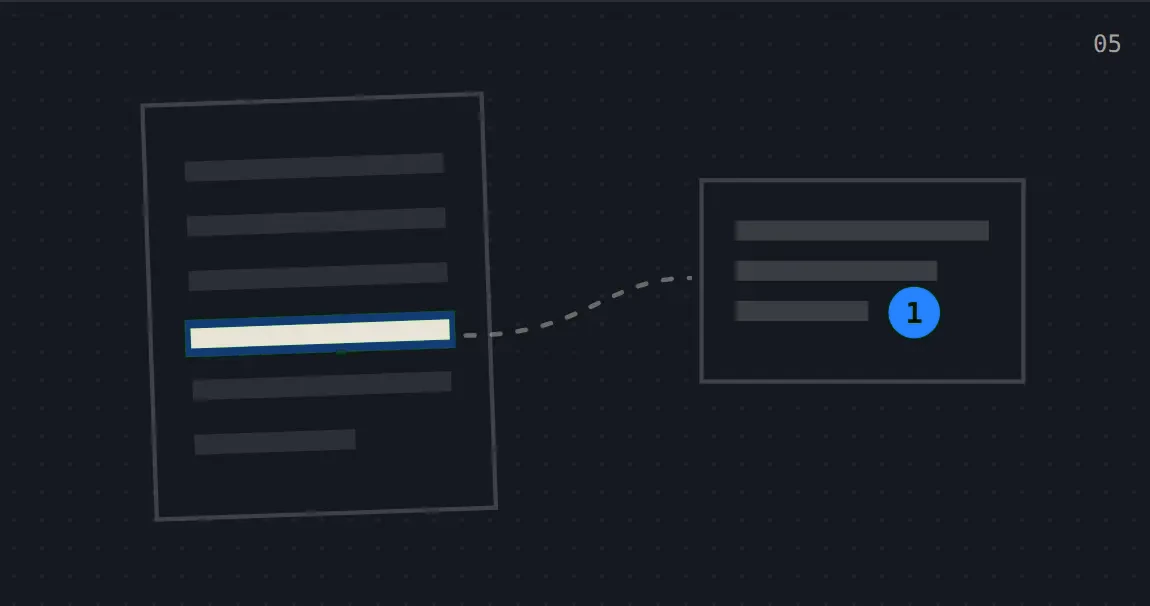
The design rule we settled on is that a citation is not a footnote, it is a navigation target. Clicking it has to land on the original page with the cited passage visibly marked.
That sounds cosmetic. It is not — it changes the data model. If a citation only has to look like a reference, storing a document ID is enough. If it has to resolve, you need to store the cited passage per document and per page, so the viewer can render that page and place the highlight deterministically. Retrofitting that later is unpleasant, because chunk boundaries and page boundaries are not the same thing and reconciling them after the fact means re-ingesting the corpus.
So: decide early whether citations resolve. If they do, page-level provenance is part of the ingestion schema, not a display concern.
Three surfaces, not one
A chat box is the smallest part of a system like this. The demonstrator has three surfaces because three different people evaluate it:
| Surface | Who cares | What it has to prove |
|---|---|---|
| Assistant | End users | Answers stream, cite, and resolve to a page |
| Source viewer | Reviewers, compliance | The claim exists in the original document |
| Ingestion + retrieval ops | The team running it | What is indexed, what failed, what re-indexing costs |
The third one is the one most demos skip, and it is usually the one that decides procurement. Knowledge-ops teams are not evaluating answer quality in the abstract — they are asking who gets paged when ingestion silently drops 12 documents. Retrieval settings that matter operationally (top-K, similarity thresholds, whether a reranker is in the path, which model is serving) belong on a real screen, not buried in a config file.
Streaming is a trust signal, not a UX flourish
Answers render token by token. We tried it both ways, and the difference is not about perceived speed.
Text that appears instantly and complete reads as canned — users assume a lookup table or a cached response. A stream reads as a model working through the question now, over this corpus. It is the same content either way; the delivery changes whether people believe the system is actually reasoning over their documents.
That is worth knowing before you optimise for time-to-first-full-answer and accidentally make the system feel less credible.
Self-hosting is a data-residency answer, not a cost one
Self-hosted inference usually gets pitched on cost. In practice, the reason it comes up in enterprise conversations is residency: which jurisdiction the documents are processed in, and whether a third party sees them at all.
That matters more the moment you work across regions — UK GDPR, UAE PDPL, and India's DPDP all push in the same direction for internal document corpora. Keeping a self-hosted configuration path open is cheaper than retrofitting it after a security review says no.
Where the honest limits are
A few things we would flag to anyone building this:
- Citation coverage is not answer quality. A system can cite correctly and still retrieve the wrong passage. Provenance makes errors findable; it does not make them rare. You still need retrieval evaluation.
- Page-level highlighting degrades on bad scans. OCR quality sets a ceiling on where a highlight can be placed, and scanned documents need a different ingestion path than born-digital PDFs.
- Three surfaces mean three things to maintain. Worth it when the buyer runs the system; overkill for a small internal tool used by four people.
What this means if you are scoping one
The short version: decide whether your citations have to resolve before you design ingestion. If they do, page-level provenance goes into the schema on day one, the source viewer is a first-class surface rather than a modal, and the ops screens are part of the product because the person who runs it is part of the buying decision.
Everything above comes from building the demonstrator, not from a deployment — the live walkthrough is on the EcoMind AI case study, and the other builds are under case studies. If you are working through a similar problem on your own documents, send us the workflow and we will tell you honestly whether it needs retrieval at all.
← Back to AI for owner-led service businesses