
When the owner cannot see what is happening
Status updates that take an hour to assemble are a data-visibility problem, not a reporting one. Why we build the dashboard before the automation, and which numbers are worth putting on it.
Part of AI for owner-led service businesses: what to automate, what to keep human
There is a specific kind of tiredness that comes from running a business you cannot see. You know roughly how things are going. You cannot say precisely. And finding out precisely costs someone an hour, so you ask less often than you should — which means decisions get made on a feeling that is a week out of date.
The instinct is to call this a reporting problem and ask for a weekly report. It is usually a visibility problem, and a report makes it worse, because a report is a snapshot that is stale the moment it is sent.
Why the hour exists
The hour is almost never spent analysing. It is spent assembling:
- Open jobs live in one tool, invoices in another
- Some status only exists in someone's head or a WhatsApp thread
- The spreadsheet that reconciles them is maintained by one person
- Two systems disagree and someone has to decide which is right
Every one of those is a plumbing problem. No amount of AI summarisation fixes a number that two systems disagree about — it just produces a confident summary of the wrong figure.
Build the dashboard first, and here is why
We recommend visibility before automation on almost every engagement, for three reasons that have nothing to do with dashboards being easy.
It changes behaviour immediately. A visible count of overdue items gets acted on without anyone being asked. Measuring a thing in public is itself an intervention.
It tells you where automation would actually pay. Most owners are wrong about where their time goes — not carelessly, but because the painful thing is memorable and the frequent thing is invisible. A week of real data reorders the priority list almost every time.
It gives you a baseline. If you automate first, you can never prove the automation helped, because you have nothing to compare against. This is the single most common reason teams cannot tell whether an AI project worked.
Which numbers are worth showing
The temptation is to show everything available. Resist it — a dashboard nobody can read at a glance is a report with extra steps.
For an owner-led service team, four categories cover most of it:
| Category | Example | Why it earns space |
|---|---|---|
| Flow | New enquiries today, jobs opened vs closed | Is work coming in and going out |
| Ageing | Oldest untouched item, count over N days | Where things are stuck right now |
| Load | Open items per person | Who is drowning, who is free |
| Money | Quoted, unpaid, overdue | The one that gets looked at daily |
Two rules we hold to. Every number should be current, not periodic — "right now" beats "as of Monday". And every number should have an owner or an action attached; a metric nobody can act on is decoration.
Current state rather than a periodic report — ageing and load are the two panels people actually act on.
Where AI adds something real
Once the data is in one place, AI earns its keep in narrow ways:
- Written summaries for people who will not open a dashboard. A short daily note: what changed, what is stuck, what needs a decision. Genuinely useful for an owner who is on site rather than at a desk.
- Anomaly flagging. "Enquiries from this source dropped 60% this week." Cheap to compute, easy to verify, and the kind of thing humans miss.
- Natural-language questions over the data. "How many jobs did we close last month for repeat customers?" — useful precisely because nobody wants to build a report for every ad-hoc question.
What we do not do: let a model compute the headline numbers. Counts, totals and ageing are deterministic queries. Putting a language model in that path adds a way to be wrong for no benefit. The model summarises and explains; the database does the arithmetic.
What this looks like built
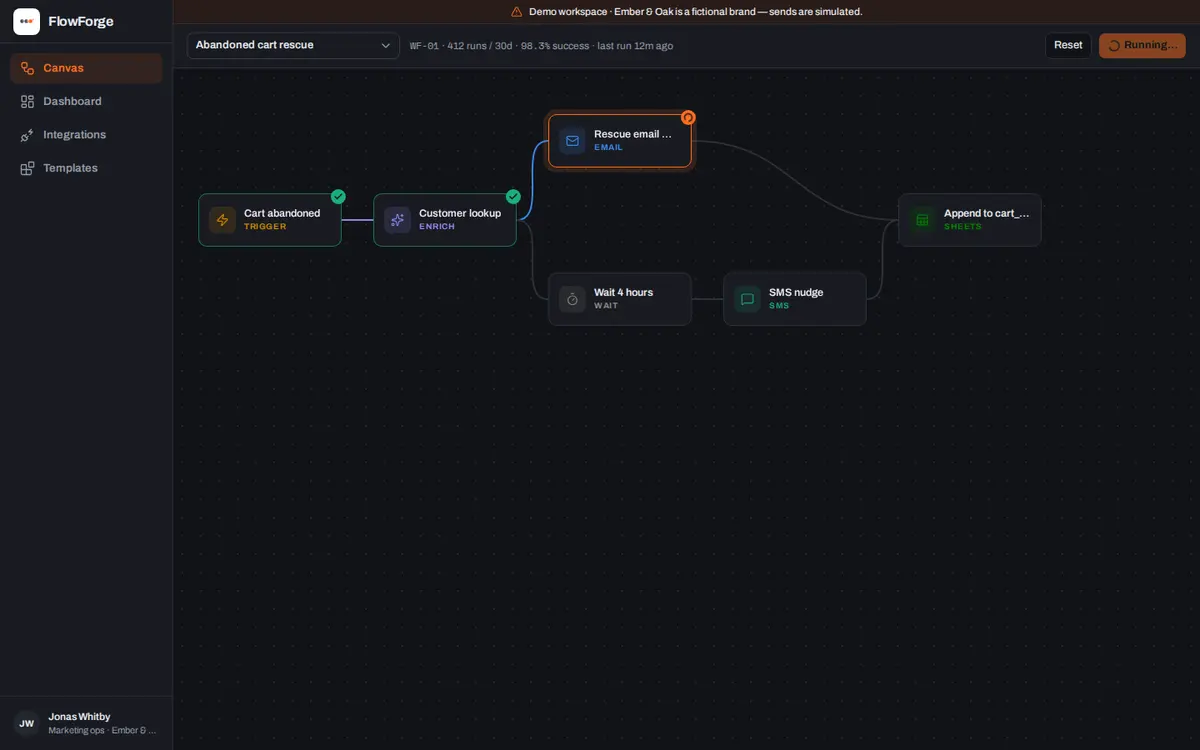
The Operations Control Tower direction is this workflow — operational visibility rather than a chatbot — and FlowForge shows the run-log side, where every automated step is inspectable rather than a black box. Related: automation you can actually inspect.
Honest limits
- A dashboard cannot fix disagreeing systems. If your CRM and your invoicing tool hold different truths, someone has to decide the rule. That is a business decision and it usually surfaces during the build, not before.
- Data entry discipline is the real dependency. If jobs are not marked complete, no dashboard knows they are. Sometimes the honest fix is a simpler process, not better software.
- Owners stop looking after three weeks unless the dashboard is where a decision actually gets made. Tie it to a routine — a Monday review, a daily standup — or it becomes a page nobody opens.
How to tell if this is your problem
If getting a current picture of the business requires asking a person, and that person needs more than five minutes, this is your workflow. And the diagnostic is worth doing honestly: time it once, rather than estimating.
← Back to AI for owner-led service businesses