It read the scanned datasheet. And it can prove it.
OCR + vector search + chat over a messy industrial catalog — where the answer quotes a number that exists only inside a photocopied scan.
Live demos are password-gated — request access via the contact page and the password comes back in minutes.
Product catalogs live in scanned datasheets and supplier PDFs that keyword search can’t read — so support answers come from memory, or not at all.
A catalog assistant that OCRs documents and images into embedded text blocks, answers product questions with the matched source attached, and shows the scan beside its extraction — confidence scores and all.
- A chat answer quoting a spec that exists only inside a scanned image
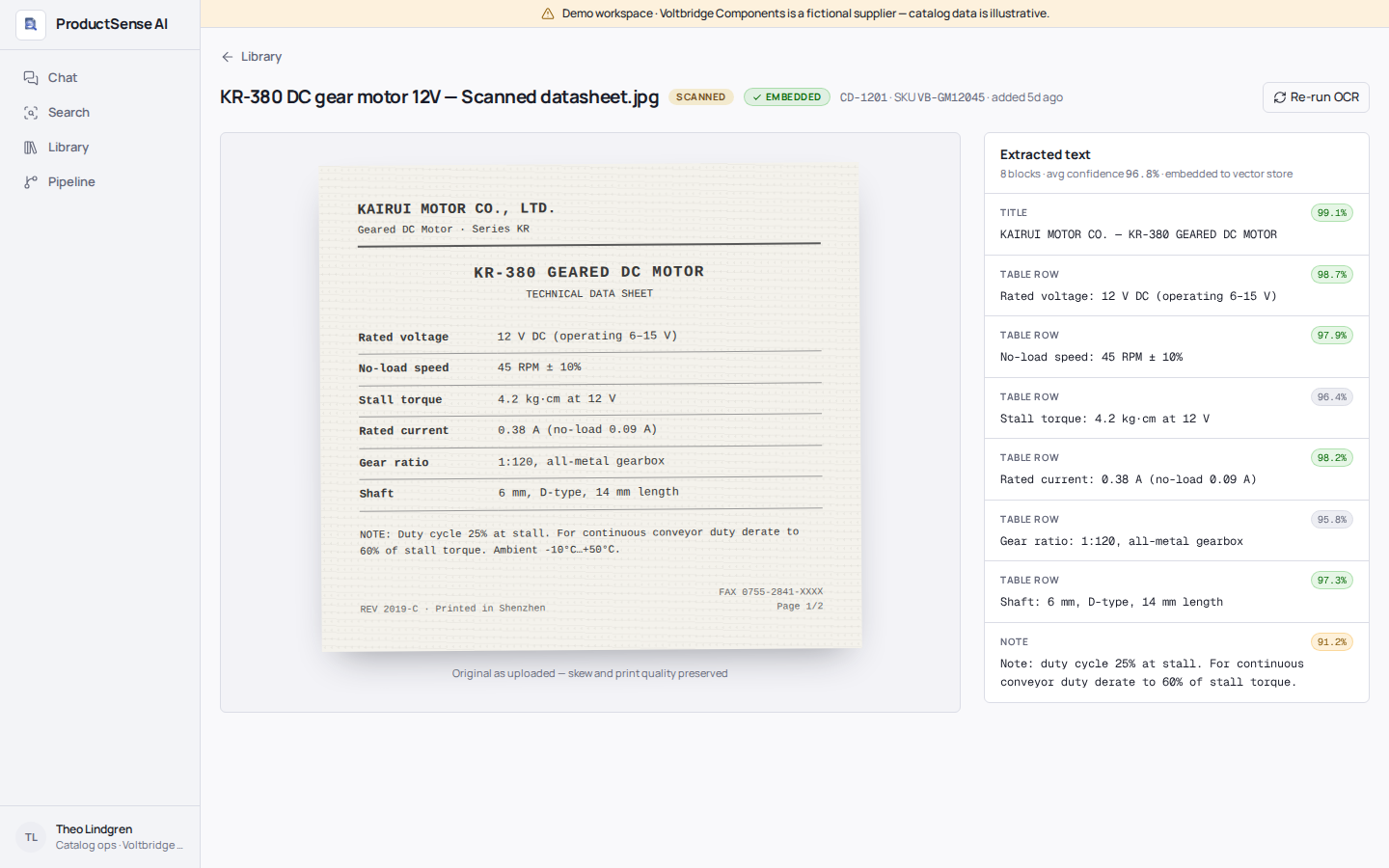
- The OCR split view: skewed photocopy left, per-block extraction right
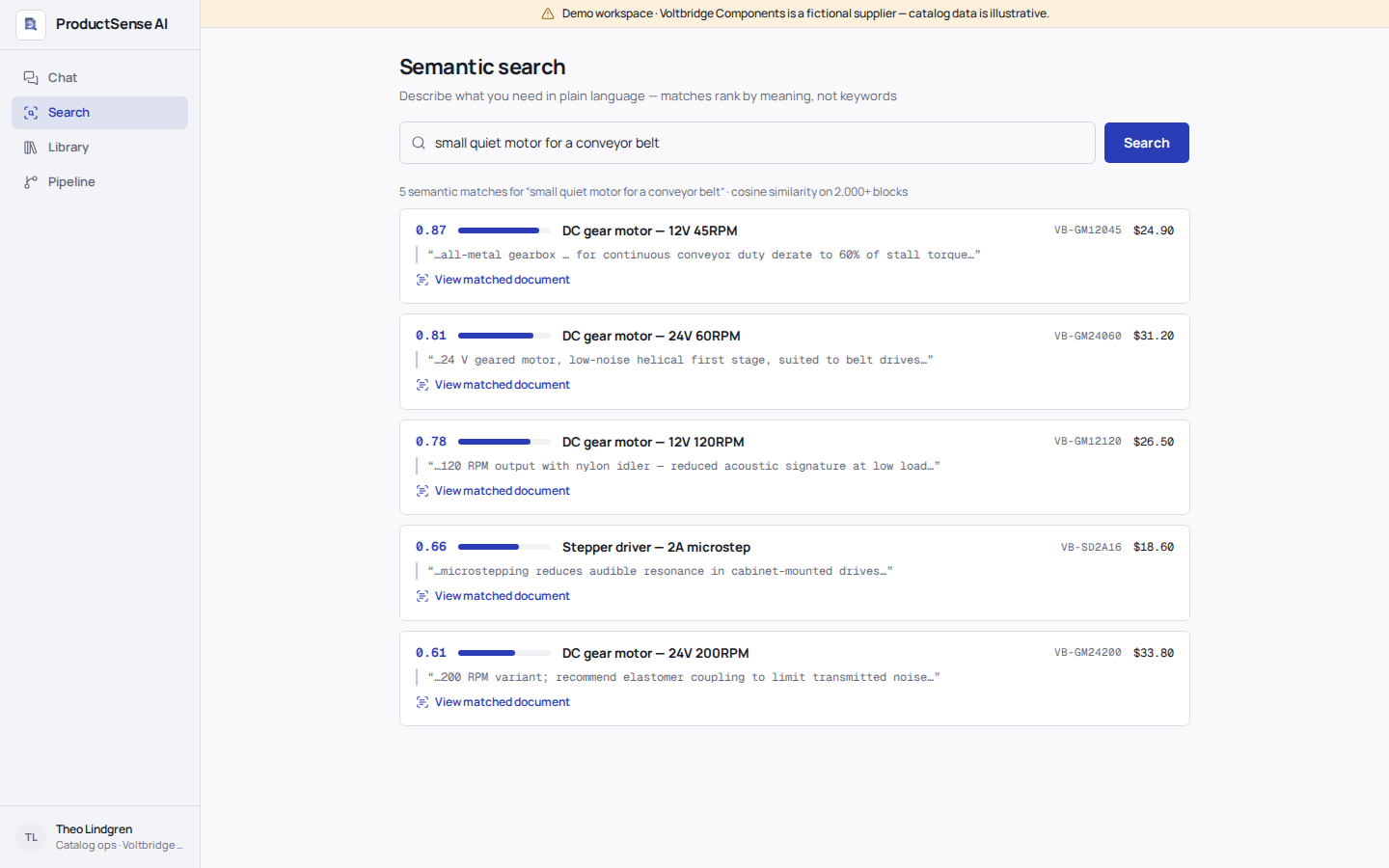
- Semantic search ranking products from a vague plain-language query
The challenge
“Search our catalog” fails exactly where it matters: the stall torque is printed in a 2019 fax-quality scan, not in any typed spec sheet. If the system can’t read images, it can’t answer.
And OCR claims are cheap — the interface has to prove extraction happened, block by block, with confidence the buyer can inspect.
The solution — three decisions
Stage the “it read the image” moment
The hero answer quotes 4.2 kg·cm stall torque — a figure that exists only in the scanned KR-380 datasheet — and links straight to the split view that proves it.
Make the scan believably ugly
The rendered datasheet is skewed 0.4°, photocopy-speckled, typewriter-set. Everything around it is ruler-straight; the contrast is the point.
Confidence is a first-class value
Every extracted block carries its OCR confidence as a chip — 96.4% on the money row — because “trust me” is not an enterprise feature.
How it works
The demo implements this shape end to end with a simulated service layer — the “extend for production” section lists what swaps in for live deployment.
Product tour
The photocopied original — skew intactPer-block confidence: 96.4% on the spec row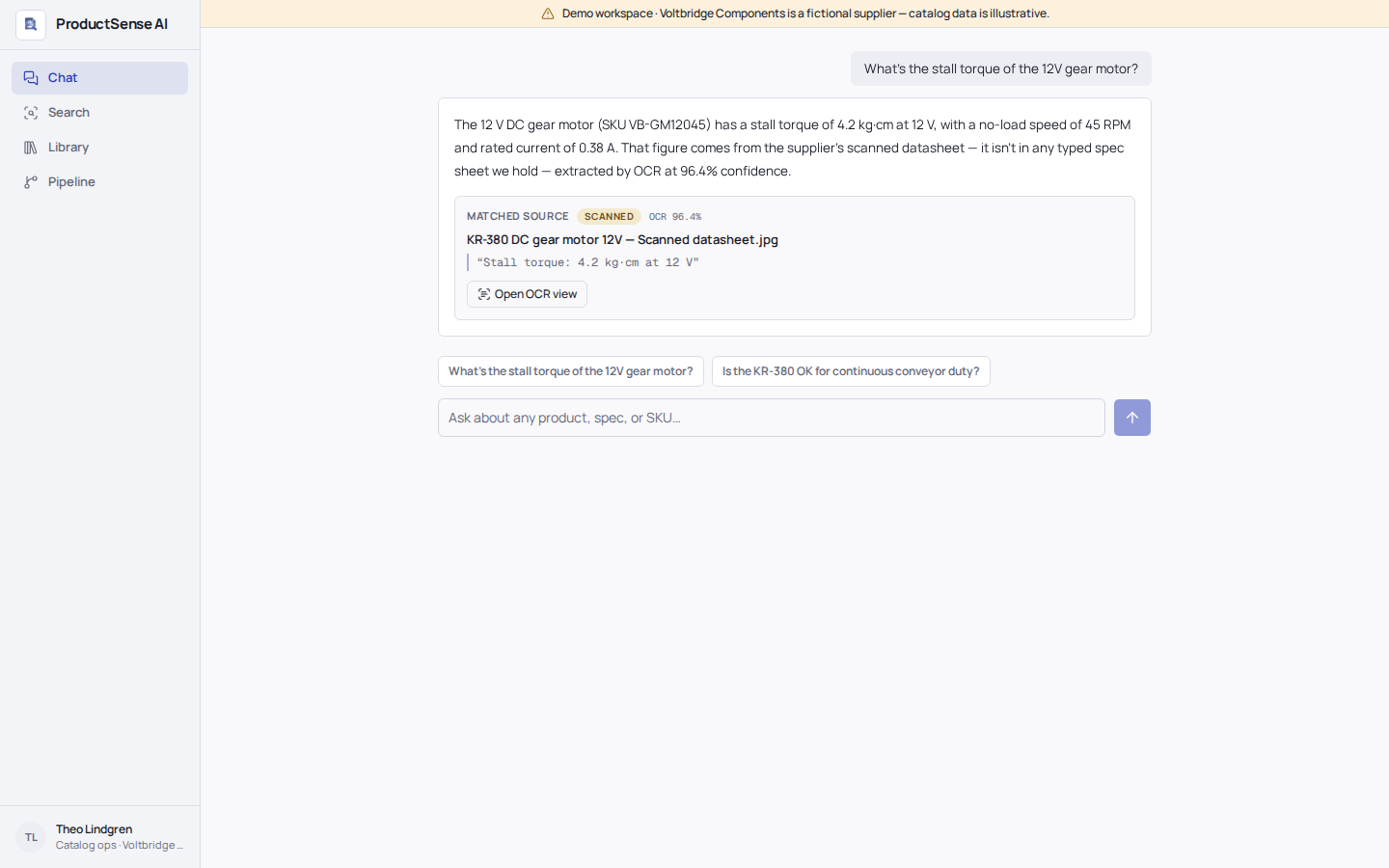
What the demo shows
- A scripted conveyor-duty question answered from the scan’s fine print
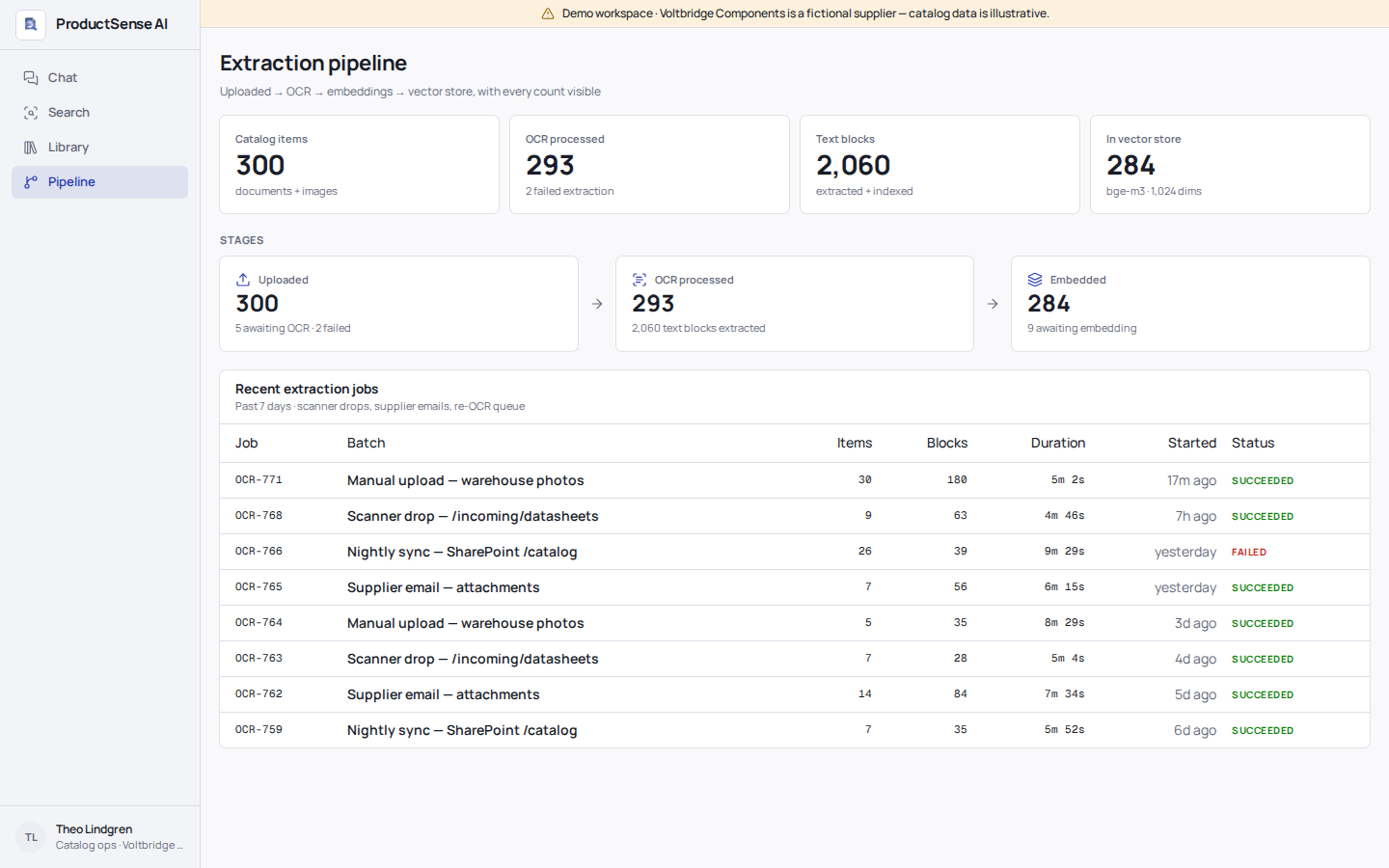
- 300 catalog items across 80 products with pipeline states
- Search that ranks by meaning, with a keyword fallback that also works
- A re-OCR action wired into the low-confidence queue
Under the hood
- The scan is CSS, not an image asset: skew, speckle, and print styling render a convincing photocopy that stays crisp at any size
- Hero OCR blocks are hand-authored to match the scan exactly; other documents get plausible generated extractions
- Search results derive from the product catalog, so every hit links to a real document view
- Counts reconcile: library totals, pipeline KPIs, and block sums come from one dataset
Voltbridge Components is fictional and labeled as a demo on every screen. Nothing here is presented as client work: no client names, no outcome metrics, no testimonials. The proof is the running product — open the live demo above and check every claim.
What we’d extend for production
- Real OCR (Tesseract/cloud) with layout-aware block detection
- Embedding search over extracted blocks with hybrid keyword fallback
- Supplier-email ingestion dropping attachments straight into the queue
Build something like this.
Fixed scope in writing before any money moves, demos during the build, and full code ownership at handover.