A form fill becomes a booked appointment. Nobody touched it.
AI intake that answers from the business’s own documents, follows up by SMS, and books the calendar — with a visible audit trail for every step.
Live demos are password-gated — request access via the contact page and the password comes back in minutes.

Service businesses drown in inquiry admin: every form fill needs a reply, a follow-up, and a booking — hours of phone tag per day.
A two-sided intake system: clients fill a short form and get a grounded answer by text; staff see every inquiry arrive with an AI-drafted reply, its source citation, and a stitched automation trail ending in a calendar event.
- One inquiry followed end to end: form → grounded SMS answer → booking
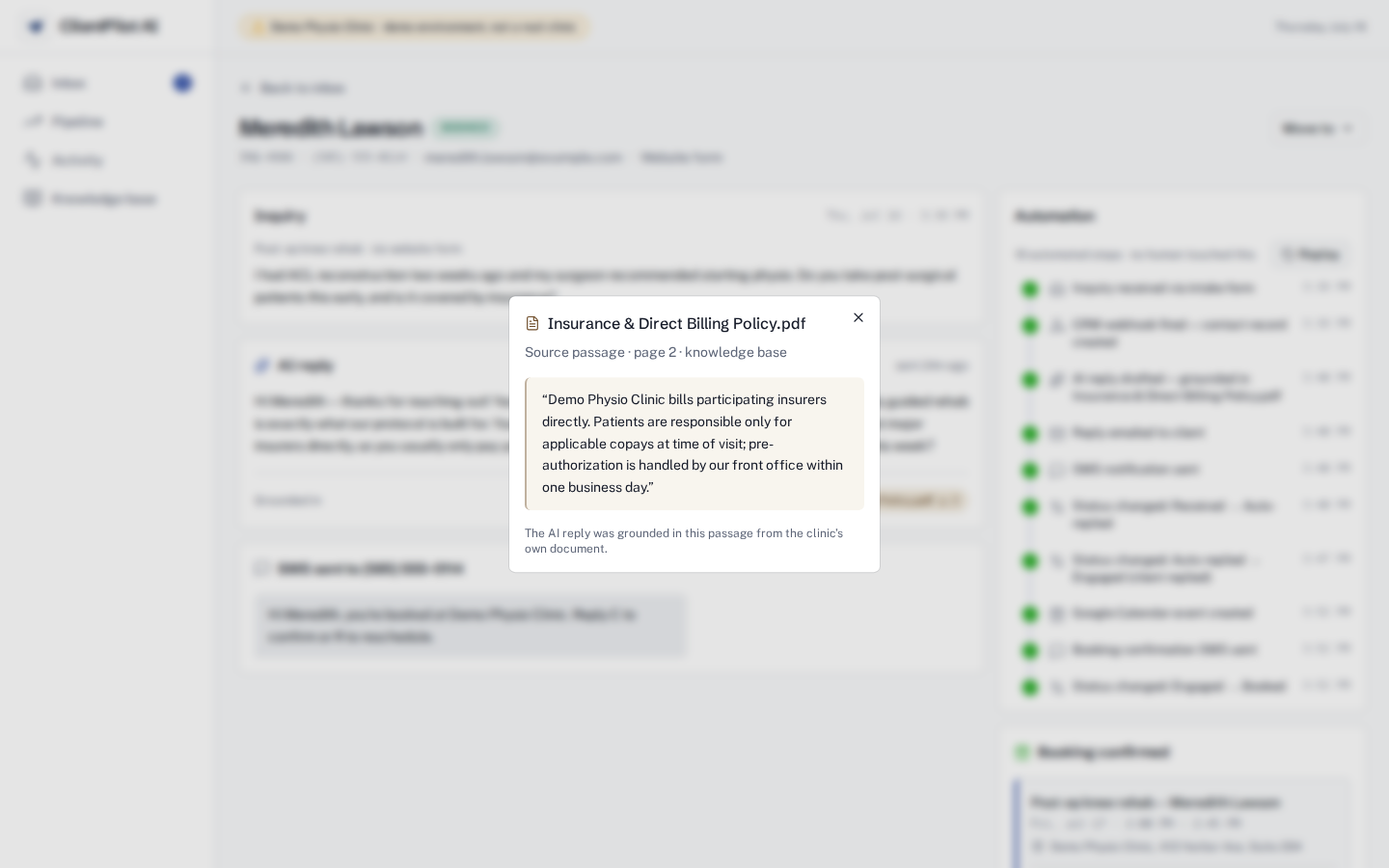
- Every AI reply citing the exact clinic document it came from
- A 10-step automation thread proving no human touched it
The challenge
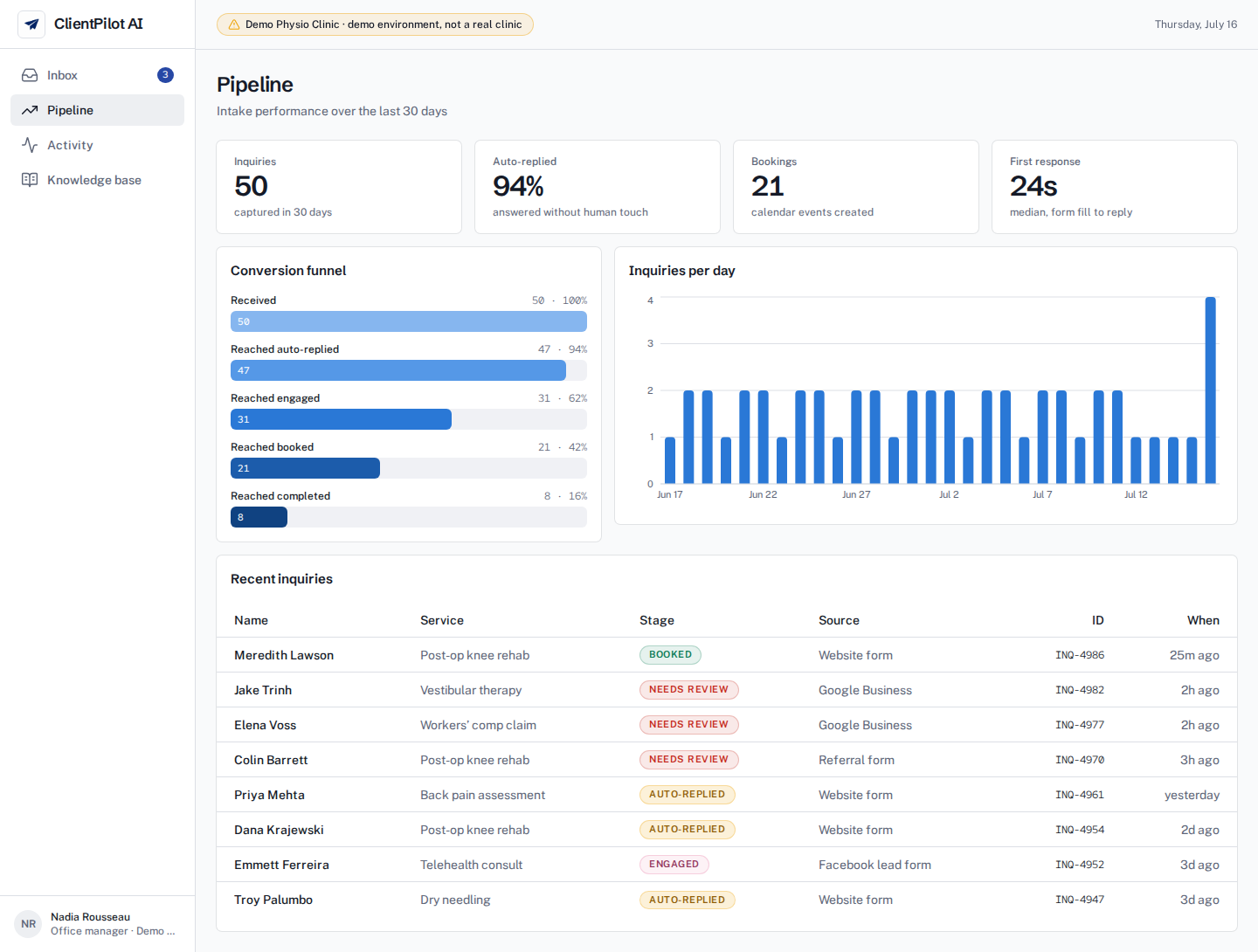
The office manager’s day is a queue: read the inquiry, look up the policy, write the reply, chase the booking. Multiply by fifty a month and intake becomes a part-time job nobody was hired for.
Automation without evidence is a hard sell — the owner has to be able to see what the machine said and where the answer came from before they trust it with clients.
The solution — three decisions
Citations as a first-class UI element
Every AI reply carries a small source tag naming the document and page; clicking opens the exact passage. Grounding is visible, not claimed.
The automation thread
Webhook fired → reply drafted → SMS sent → booking created — rendered as a stitched vertical trail with timestamps. It is the “nobody touched this” proof, replayable on camera.
Escalation as a feature
Clinical and claims questions are deliberately held for staff with a visible reason — the assistant knowing what not to answer is part of the pitch.
How it works
The demo implements this shape end to end with a simulated service layer — the “extend for production” section lists what swaps in for live deployment.
Product tour
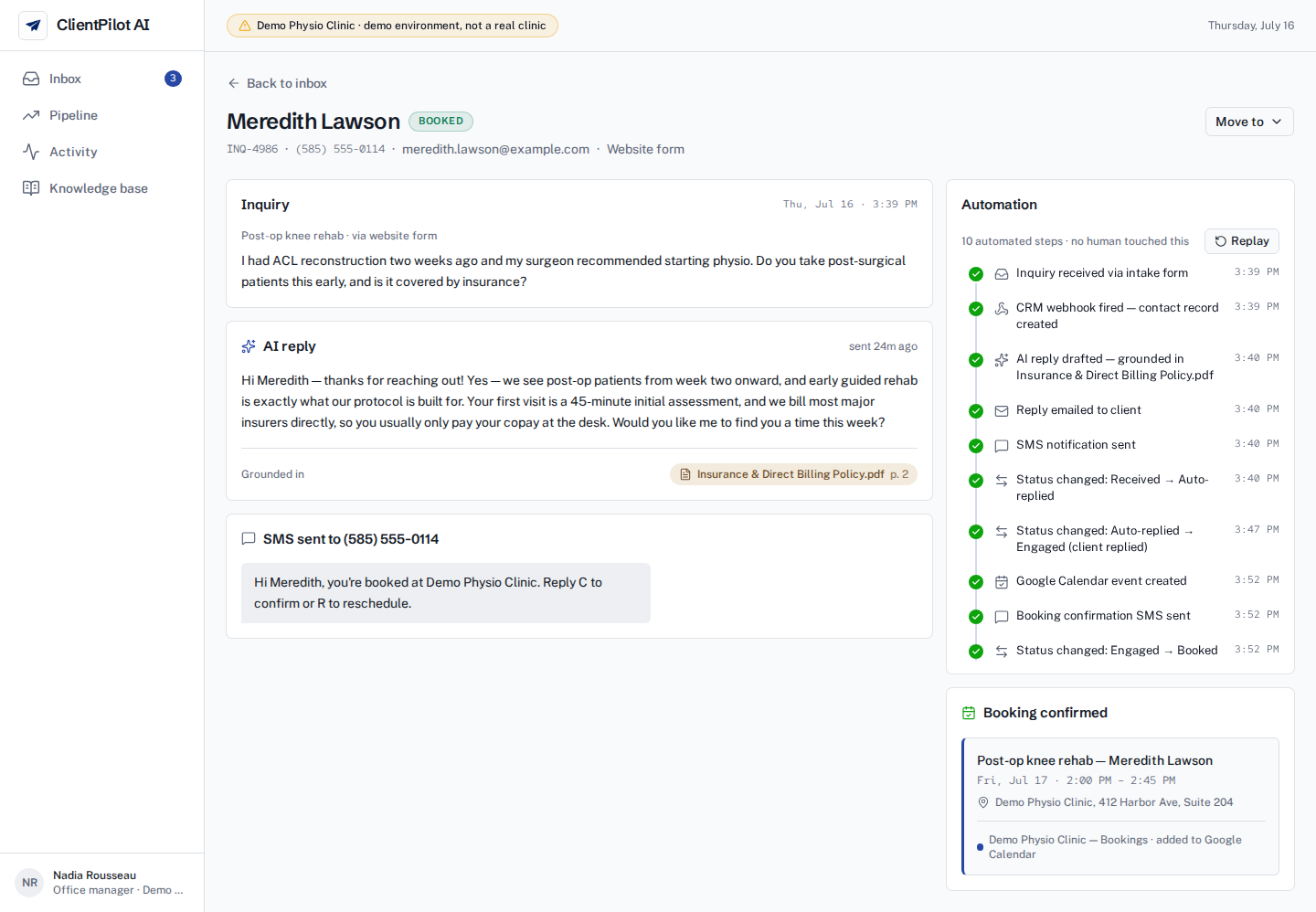 Reply cites the clinic’s own policy PDF10 automated steps, timestampedThe Google-Calendar event it created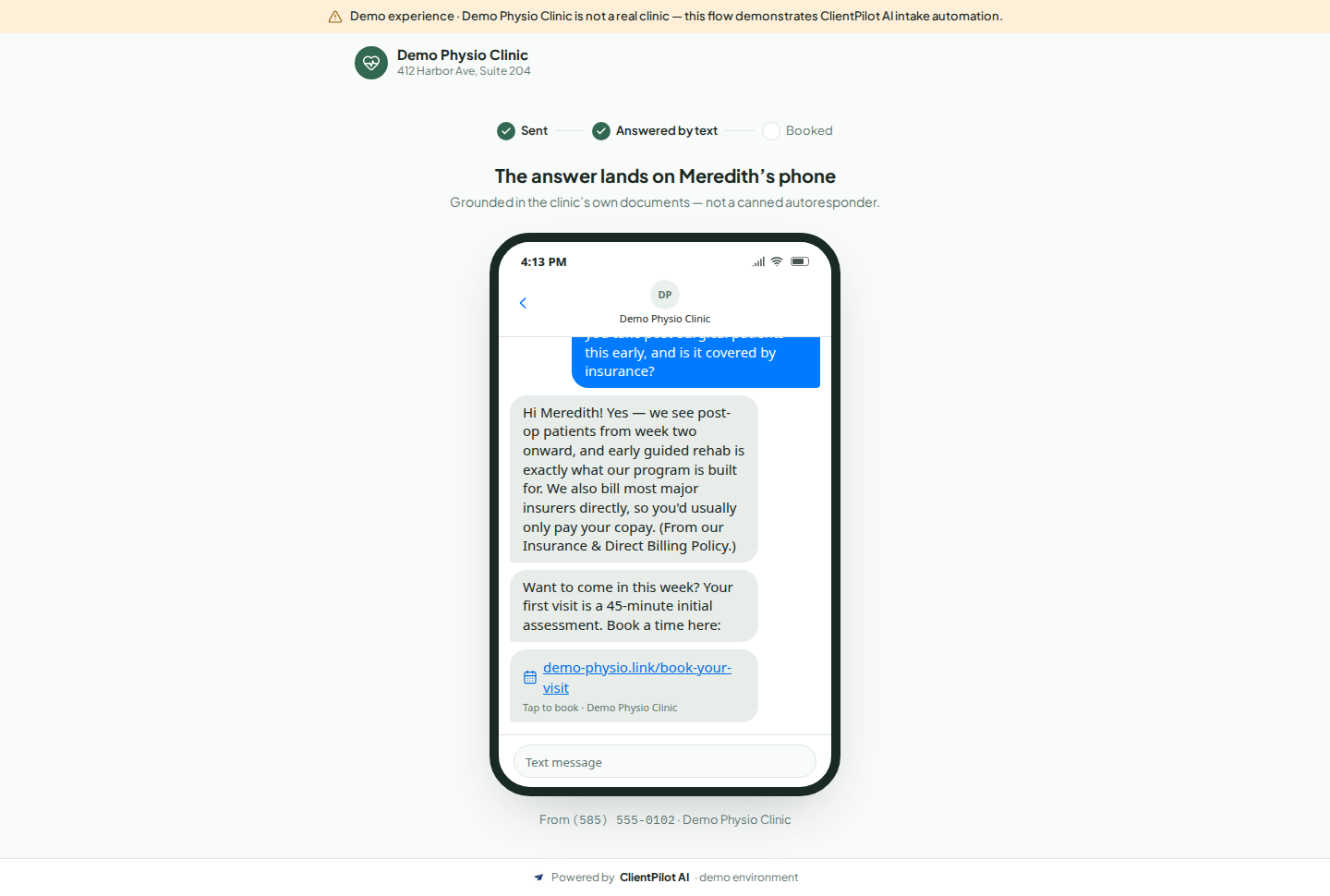
What the demo shows
- The same inquiry visible on both surfaces — client phone and staff CRM
- An SMS thread rendered natively, typing indicators and all
- Inbox rows whose reference IDs descend with recency — the details technical buyers check
- A knowledge base with indexing states powering every answer
Under the hood
- Inquiry templates with per-template message variants keep 50 mock inquiries free of duplicate rows
- Escalation logic models a real routing decision: clinical/claims topics never get auto-replies
- A single automation-event model renders both the per-inquiry thread and the 30-day activity feed
- Funnel math is computed from the same store the tables read — every KPI reconciles
Demo Physio Clinic is fictional and labeled as a demo on every screen. Nothing here is presented as client work: no client names, no outcome metrics, no testimonials. The proof is the running product — open the live demo above and check every claim.
What we’d extend for production
- Real RAG over uploaded documents with chunk-level citation offsets
- Twilio SMS + Google Calendar integrations behind the same event model
- Feedback loop: staff edits to drafts fine-tune reply style
Build something like this.
Fixed scope in writing before any money moves, demos during the build, and full code ownership at handover.